















The Short Version
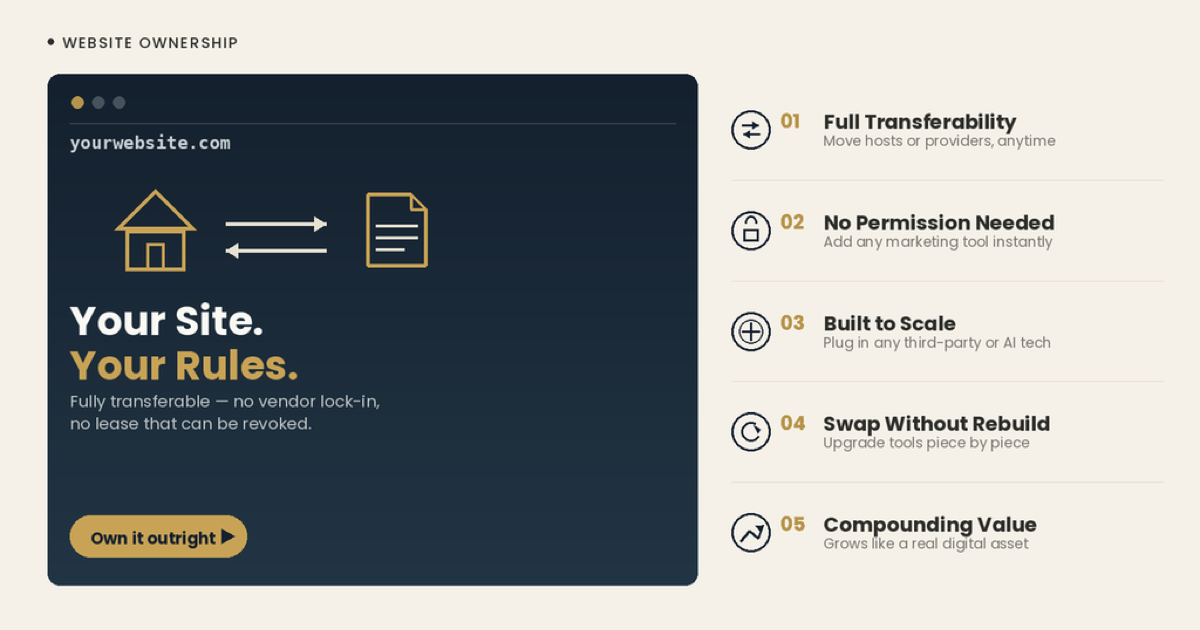
Most luxury agents don’t own their website — they rent a slot on a proprietary platform. True ownership means five things: your site is transferable if the provider raises prices or shuts down, you can plug in any marketing tool without asking permission, you can scale with any third-party or AI technology, you can swap out tech without a rebuild, and the whole thing keeps compounding in value instead of expiring with a contract. Here’s why that distinction matters more with every year that passes.
Ask most agents who owns their website, and they’ll say “I do.” Ask their web provider the same question, and the honest answer is often different. If your site lives inside a proprietary builder — one where the code, the content, and the design can’t leave that platform — you don’t own a website. You’re leasing space on someone else’s system, and you’re one pricing email or one shutdown notice away from starting over.
1. True Transferability: Your Website Survives Any Vendor
Proprietary platforms build their business model around lock-in. If that provider goes out of business, gets acquired, or triples its monthly fee, your only options are pay up or lose everything — your domain history, your SEO equity, your content, your design. A truly owned website, built on open architecture like WordPress, is fully transferable. You can move hosts, change developers, or bring it in-house at any time, because nothing about it is proprietary to begin with.
2. No Permission Needed: Limitless Marketing Integrations
On a closed platform, adding a new tool — a valuation widget, a chat assistant, a CRM connection — usually means waiting on the provider’s roadmap, or discovering it simply isn’t supported. On an owned website, you connect whatever marketing or lead-gen technology fits your business, the moment you want it, without asking anyone’s permission first.
3. Built to Scale: Add Any Third-Party Technology or AI Tool
The pace of new AI tools in real estate isn’t slowing down. Instant valuations, conversational assistants, smart CMAs — the list keeps growing, and it will keep growing for years. A website built on open, standard technology can integrate essentially any third-party service or AI tool as it emerges. A proprietary platform can only offer you what it decides to build, on its own timeline.
4. Swap Tech Without Rebuilding: Future-Proofing by Design
Technology you rely on today won’t be the best option in five years. On an owned website, replacing an outdated tool — a chat provider, an IDX feed, a valuation engine — is a swap, not a rebuild. The foundation stays exactly where it is while individual pieces upgrade around it. On a proprietary system, that same swap can mean migrating the entire site.
5. Ownership Compounds: Why It Matters Over the Next Decade
A website you own accrues value the way a property does: domain authority builds, content compounds in search, and every integration adds capability rather than dependency. A website you rent resets that value the moment the lease ends. Agents thinking in ten-year terms, not ten-month terms, are the ones who end up with a real digital asset instead of a recurring bill.
The Thread That Ties Them Together
Every one of these advantages traces back to the same root: control. Transferability, unrestricted marketing, unlimited scalability, and easy tech swaps are all just different expressions of owning your platform outright instead of renting access to someone else’s.
A Word of Caution
Ownership isn’t automatic just because you paid for a website. Confirm you actually hold the domain, the hosting account, and the source files in your name — not your provider’s. If you can’t export your content and walk away today, you don’t yet have the ownership this post is describing.
Bottom Line
The agents who’ll still be winning listings in 2036 aren’t the ones with the flashiest site today — they’re the ones who own a foundation flexible enough to absorb whatever comes next. That’s the kind of website we build: yours, transferable, and built to scale for as long as you’re in business.
Frequently Asked Questions
1. What does it actually mean to “own” a real estate website?
Ownership means you control the domain, the hosting, and the underlying code — not just the login. If you can export your content and move to any host or developer without the platform’s permission, you own it. If you can’t, you’re renting space on someone else’s system.
2. What happens to my website if my current provider goes out of business?
On a proprietary platform, a shutdown can mean losing your site entirely — content, design, and SEO history included. On an owned website built on open technology like WordPress, the site itself is independent of any single vendor, so it transfers cleanly to a new host or developer.
3. Can I add my own marketing tools to a proprietary website builder?
Usually only what the platform explicitly supports. New integrations depend on that provider’s roadmap and approval. An owned website lets you connect any marketing tool, CRM, or lead-gen service you choose, on your own timeline.
4. How does website ownership help with scalability?
An owned site is built on open, standard technology, so it can integrate essentially any third-party service or AI tool as your business grows — without waiting on a platform vendor to build or approve it first.
5. What if I want to replace a tool I’m using, like my chatbot or IDX feed, down the road?
On an owned website, that’s a straightforward swap — the new tool plugs into the same foundation. On a proprietary platform, replacing a core tool can force a full site migration, since everything is bundled together.
6. Is website ownership really worth it if a proprietary platform is cheaper upfront?
It depends on the time horizon. A proprietary platform can look cheaper month to month, but the cost shows up later — in lock-in, lost equity if you leave, and limits on what you can add. An owned website is an asset that compounds; a rented one is an ongoing expense that can vanish.
7. How do I check if I currently own my website or I’m renting it?
Confirm three things: the domain is registered in your name (not your provider’s), you have access to the hosting account, and you can export your full site content. If any of those isn’t true, you’re on a proprietary platform, whatever the sales page called it.
8. What’s the long-term risk of staying on a proprietary platform for 5–10 years?
The risk compounds. Each year you’re on a closed platform, you accumulate more content and SEO equity that’s harder to move, while newer AI and marketing tools keep launching that platform may never support. The gap between what an owned site can do and what a rented one can do only widens over time.